Tuesday, August 28, 2012

Return to Paradise, at Last


Chapter Five: Paradise At Last

Samoa
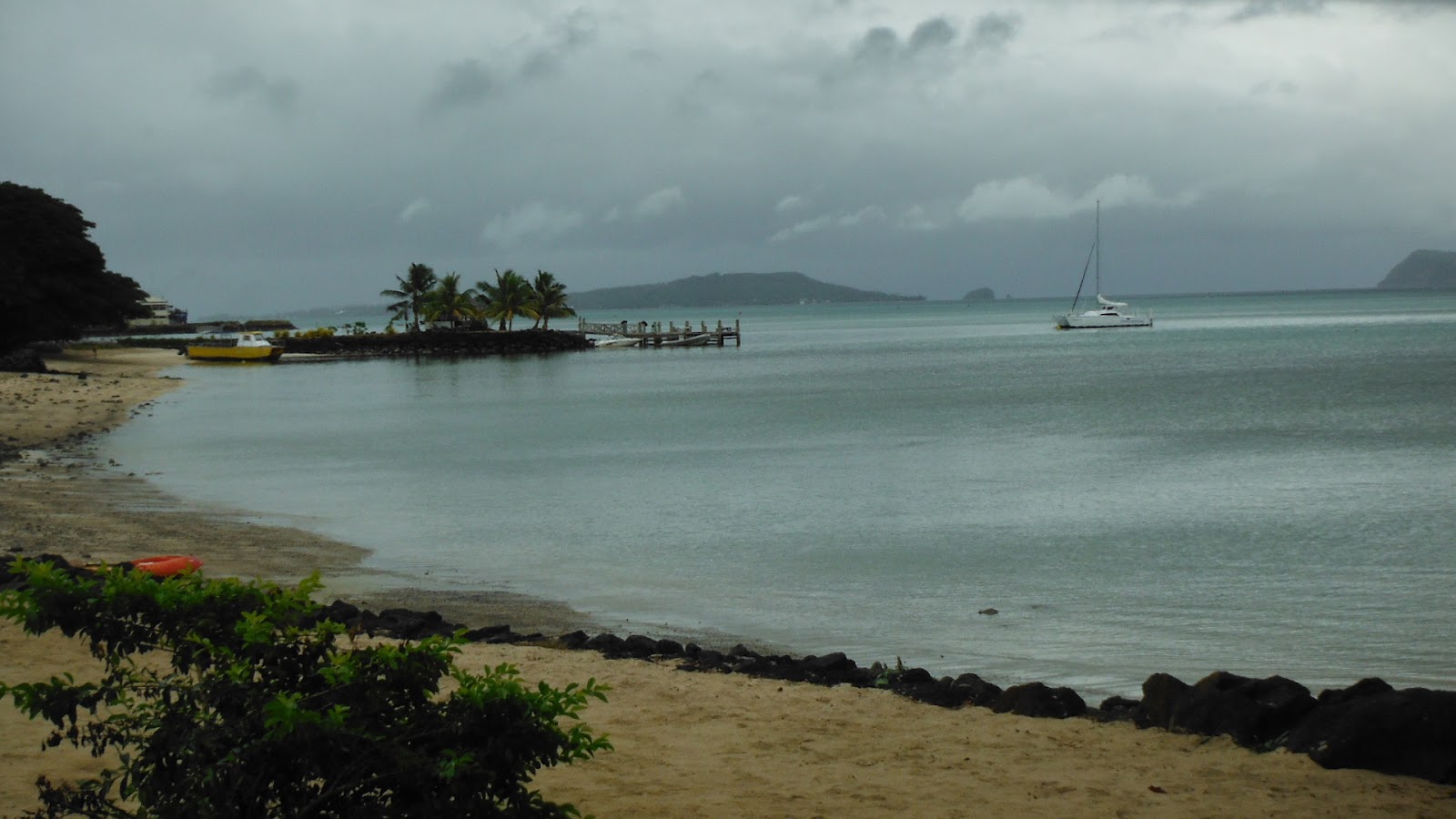
We landed on Upolu, Samoa, about 11:30 PM, managed to get through customs and immigration and into the best hotel of the whole trip: Aggie Grey’s Beach Resort.  This is our only upper class, 5 Star, resort of the trip: a couple restaurants, pool with swim-up bar, golf course being developed, all on the northwest coast of the island, with Savaii in the distance and the gorgeous Pacific all around us.  Of course, the place also comes with lots of screaming under-parented Australian kids…but a small price to pay for Paradise, champagne sunsets right outside our room and the incredible Pacific we had hoped to see. 

The original Aggie Grey’s Hotel is in Apia, the capital city (well, town) down the coast 45 km.  The Hotel has been an institution of renown since WW2 and has seen its share of celebrities.  We stayed there once 30 years, but I don’t remember anything special.  (We missed the weekly floor show and "siva" dance, originally performed by Aggie herself, now performed by her granddaughter.)
Millie at Breakfast

Beach Front at Aggie's

The cloudy weather followed us to Samoa,and we tried hanging out at the pool and working on our tans without success the first day, Saturday July 14.  We studied the possibilities, bought an hour of internet to check the weather, and decided to book snorkeling for us and SCUBA for the girls for Sunday at the dive shop down the beach. 

The weather was still a little cool, cloudy and windy Sunday morning when all of us had our first dives (girls SCUBA, Gail and I snorkeling), but by afternoon, it was clear, calm and perfect.  That second dive was a mile off shore, in a sea that deep blue and shallow emerald green you dream of, and the sunlight lit up the coral and the fish in the Fish Bowl CafĂ©, as they call the diving site. 

But the best part was that we were watching our girls six meters below us.  They have now had four open water dives and seemed completely comfortable.  Abby announced just before we left that she didn’t see herself coming back to be a SCUBA instructor here.  We didn’t know it was even an idea. 
The Wide Pacific

Monday we rented a car and drove around the island.  We caught another mostly sunny day and followed the beach road south then east along the coast.  The villages in Samoa, unlike Fiji, are colorful places with lots of flowering plants everywhere and plants that add color with their leaves.  Big ornate churches were the dominant structure in every village, each appeared to have been freshly painted just for us.  We drove slowly and took lots of photos, of course. 

The road was pretty memorable as well.  It left the shoreline after several villages and moved over a pass between the hills, then back down into a valley.  The road got less paved and narrower as we went, finally coming to a stream that we had to cross.  Actually, there was a low water “bridge” and the clear water rushing down the mountain and across the road was only a few inches deep.  Fortunately, we had rented a 4WD SUV, so I was sure we could ford the creek.  The Corolla taxi in front of us almost didn’t make it, though.  I got to wade across and push a little to get him through.  It was all part of the adventure. 

"Return to Paradise" Beach


After a few wrong turns, we found the Beach. “Return to Paradise” Beach was the set for a Gary Cooper movie from the 40s; none of us have seen the movie, but the beach was incredible—not for swimming, just for walking around and looking. In the 80s, it was just a barely marked beach you could just drive to, with a little help from the villagers.  Now, it’s a tourist attraction with a guesthouse and a couple chiefs hanging out at a "fale o'o" (coconut hut) to take your 10 Tala (about $4US.) per car.  

The beach was a hundred yards of sand surrounded by coconuts and bordered by black lava and white coral. A major lava flow had cooled at the beach, creating lots of pools, and the waves break close, so there is a constant rush of water over and around the rocks.   Gail and I came here Christmas, 1980, and we have a great photo of Gail on the beach.  The girls thought it was just as cool.  So we took lots of pictures and played on the rocks until it was time to head to the waterfall. 


Millie in the middle

Fish Bowl Cafe


Last Look at Paradise

The waterfall, on the way to Apia, is a hundred feet high and flows over a cliff in the middle of the rainforest.   The viewing area is opposite, just off the cross-island road, and that day covered in mist and fog.  The guy who lives across the road will help you down a path to the pool at the bottom for 100 Tala, but we decided to pass. 

We drove back into blue sky and brilliant sunshine in a few minutes and soon found ourselves at the waterfront of Apia.  Apia struck us as mini-Honolulu from the 50s—suburbs of sorts and lots of blooming and colorfully leafed plants.  The waterfront was recognizable, even though there has been much development.  We found the place where Gail’s dad took a picture of a boy walking a horse, with the harbor in the background. 

The last day in Samoa, we checked out and then waited around the pool and beach for our flight out of paradise.  Our next stop is six nights at a two-bedroom apartment on the beach just north of Cairns, Australia, opposite the Great Barrier Reef.  The place is a different kind of paradise with a washing machine and dryer, a supermarket down the street, and BBQ grills next to the pool.  The adventure continues.

Sunday, August 26, 2012

Return to Paradise or How We Spent the Kids' Inheritance; Chapter 4

The Museum of Fiji
Our divers and the raging Pacific

Waidroka Bay Resort

Chapter Four: Fiji


The Fiji experience began at the Nadi airport, where we were met by Ali (or Ili, not sure which). He put our luggage and us in a Waidroka Bay Resort van and began a three-hour nighttime drive to the resort.  We stopped in the town of Nadi for dinner, then got into the driving on the mostly paved Queen’s Road, which follows the coast, mostly, to Suva.  Thirty years ago it was all gravel.


This is not the India/Bangladesh driving that we had become accustomed to, but pretty developing-world in its own way. Lots of speed limits in villages, speed bumps and the occasional broken down car.  Few people and fewer lights between villages.  

After a couple hours of steady rain, Ali pulled off the main road into a gravel lane, up and over dark hills for several kilometers until the road ended at the almost completely dark “resort”.  No one was present to greet us.  Ali jumped out and found a note in the key box, grabbed the key and we climbed a long set of stairs, with our luggage, in the rain, up to our room.

Our bure away from home
The room had only beds for three, the air conditioner remote could not be found and there was no one to complain to.  While we each swore and complained to each other, Gail read the note, looked at the hotel information and realized we were in the wrong room.  Ali, of course, was long gone, and it was still raining.  Millie and I grabbed an umbrella and flashlights and went off to explore.  We found our way back to the main building and located the correct note and key in the key box, and stumbled through the rain until we found the deluxe family ‘bure’ (Fijian for house), with beds for four, that we had booked.  So we brought the luggage back down the steps, through the rain, to our new little bungalow.   

Scuba Lessons
The next day we booked the girls into SCUBA certification lessons and found there really wasn’t much for Gail and I to do.  Even though the place is located in a sort of arc of a cove, there was no beach, just rocks and mud when the tide was out.  

But we weren’t driving an SUV anymore, and there was a pool.  The place focuses strictly on SCUBA and surfing, and everyday takes guests off shore to places for both.  The other guests were mostly surfers plus a father and son from Denver who had maxed out on SCUBA.  

Gail and I caught a ride the next day to Suva, Fiji's capital, and wandered around the city, checked out the museum, bought some souvenirs and had a nice lunch.  The girls are hard at the book-learning part of the SCUBA experience. 

Almost Sunny
Two days into SCUBA and the girls were out at sea for their last two dives to be certified.  The weather all week had been cloudy and rainy, but Wednesday, July 11, had a higher sky with occasional sunshine and still lots of wind.  The resort faces a lagoon with waves breaking on the reef far out to sea.  Inside that reef the wind was blowing hard enough to produce whitecaps.  So we had to hang by the pool instead of snorkeling yet again. 

At the last minute we decided to brave the waves and head out with three surfers and their mom to the “Pipes” a good place, about a mile offshore, for both snorkeling and surfing.  Fiji apparently is the home of world championships for surfing and one of the most popular places in the world for surfers.  The “Pipes” is one of the best places. The waves break out in front of some reef and it’s safe to surf.  The resort has a mooring place to tie up the boat nearby.  The surfers took their boards and swam a hundred yards or so to the Pipes while the grown-ups stayed on the boat and bobbed around.  The weather got worse and we never got to snorkel, but I did eventually get seasick.  We came back in during a pouring rain and got wet that way. 

The girls, meanwhile, were seeing a shark, a turtle and lots of fish and coral.  Late that afternoon, the local employees invited the guests to a kava ceremony.  Kava is a root that is ground, pounded in this case, and then mixed with water in a kava bowl to a consistency of muddy water.  In Samoa, the ceremony is a very tradition-laden event, only done by a village princess and with specific sequence of events.    (We have a bowl from Samoa at home.)

Making Kava
Delicious
Here it was more of an endurance test—how much can we get the tourists to drink?  The drink makes your tongue numb and generally induces a calm, restive state.  It’s also a diuretic.  As easily the oldest person there, I was designated the “chief” and had to start each round.  I stayed for the entire 2.5 hours—about a 12 pack; Gail and the girls bailed early. 

We gave it one more shot: waited for the weather to clear and maybe try to snorkel one more time.  In the meantime, the girls passed their written tests and are now certified to 18 meters of open water.  But the rain and clouds continued. 
On the Way to the Airport
  
Finally a Sunny Day for a walk in the Dunes
The next day, the only sunny day of the week, we left early for the airport.  We had asked to stop for some shopping, lunch, and a sand dunes national park on the way.  We wanted to make it to the airport early so Abby could find an internet connection and send off another assignment for her on-line course.  We did it all, and everything worked out.  

Looking back, it wasn't bad, but it wasn't paradise yet.  We would have to wait a couple more days.  On to Samoa!

Friday, August 17, 2012

Return to Paradise, or How We Spent the Kids' Inheritance; Chapter Three

Entering Queen Charlotte Sound, South Island


Chapter Three: South Island
One of the Southern Alps

The ferry crossing to the South Island is a two to six hour adventure, depending on the sea and the weather. We made it in about four, with pretty heavy swells moving one of us to seasickness for a while. The ships for this trip are large—lots of cars, big trucks, campers and RVs.  Once they get you parked inside the ship, you find a seat near the bar, food court or lounge or stand on one of the decks.

The Cook Strait was pretty rough until you get in the “shadow” of the South Island, then things flatten out a bit.  Then once you get into Queen Charlotte Sound, it might as well be a lake.  Since we caught a sunny, bright morning for this trip, we had spectacular viewing—just cold and windy.  The boat finally docked and we headed south down the Pacific coast to Christchurch, the most English city in NZ. 

The girls slept through this one.
The road cuts through one of NZ’s best know wine producing areas, then some hills and more sheep before heading along the actual coastline—all in sight of the Southern Alps, the snow covered monsters that seem to have just sprouted out of the pastures and vineyards.  NZ is one of the Earth newest landforms and the mountains are vertical, jagged and rocky—like the Grand Teton in Wyoming, only the range is the length of the island and almost always in view.

The Pacific was raging and roaring just like the Tasman had been on the other side two days before, big white-capped waves crashing noisily on the beaches.  The driving was slow and hard since the road hugged the coastline.  It would have been fun to drive in Gail’s car, but this big old SUV doesn’t handle like a Beetle convertible, so we plodded along, stopped for lunch at a place with a view and then headed into Canterbury, of which Christchurch is the provincial capital. 

South of Queenstown
Earthquakes devastated Christchurch in recent years and most of the downtown was destroyed or damaged to the point where you can’t see anything of the city center. We stayed on the outskirts of the town and walked a few blocks to a mall and a restaurant.  We passed churches and pubs that showed the damage.  In fact, the churches seemed to be the places that showed the most damage, maybe the 19th century stone construction did not allow for the elasticity necessary to stay upright in an earthquake.  In any case, we’ll not be adding this one to the retirement list; the next morning was once again cold and sunny as we headed toward Mt. Cook.

The drive was up, over and through the foothills and plateaus leading up to a couple alpine lakes and finally, NZ’s tallest mountain.  The mountain and its brothers block the west end of a glacier-created lake, and were framed by our motel room windows.  


At the foot of Mt. Cook
We were right at the base of the range and so close you could walk over and start climbing.  Actually, it’s maybe a mile away, but since the air was so clear and cold, it looked really close.  We scraped off the frost from the windshield the next morning and headed down the valley and around the lake toward our main South Island destination—Te Anau and Milford Sound.

Milford Sound is one of the fiords that the ice ages cut into the southwest corner of the South Island, and spectacularly green, vertical and beautiful, but the drive there is pretty spectacular itself.  We rolled past several glaciated lakes and lots more sheep before we got into the higher, ice and snow-covered part of the trip (“allow two hours, check road conditions, rent chains from the service station if needed”).  We took longer to get there, but didn’t need the chains after we checked.  We were told to beware of the black ice. 
Early Morning Mt. Cook


The Road to Milford Sound
The drive started out in clouds and fog—it was hard to tell which we were driving through any particular moment—then moved up into Alpine forest, lakes and the snow.  The NZ highway people had conveniently spread some kind of “grit” limestone chat, I guess, on the roads provide us with traction on ice, but I thought it just made the road slipperier.  


Still on the Road to Milford Sound
We came across waterfalls, icefalls, roaring mountain streams, incredible ice cycles and, of course one-lane bridges.  We even drove through a one-lane tunnel for at least a kilometer downhill, ending in a sharp curve that lead to more sharp switchbacks and curves down to the Sound.  Just before we arrived, we were stopped by the friendly NZ highway department man who told us to “drive very slowly the last 10 kilometers or so, because they hadn’t put down the morning grit yet and filling out the insurance forms for our wrecked rental car would be sooo time-consuming”. 

The Sound
But nothing ill befell us and we landed safe and sound at the Milford Sound boat harbor and got ready to board.  As with everywhere else in NZ, people thought we were a little odd: two obviously Chinese girls with a couple really white people.  And since we were surrounded by Chinese tourists, we sort of stuck out. 

The Sound was incredible…waterfalls, dolphins, seals, bright blue sky and sea and yes rainbows…well, sunny waterfalls that created rainbows.  It was all majestic and magical and unchanged from 30 years ago.  The boat took us out just into the Tasman Sea, turned around and came back on the shadow side of the Sound, stopping to let waterfalls spray us.  Dolphins followed us, and seals slept on the rocks. 

Wood Family in Winter
We drove back up through the tunnel, past the ice cycles and fog/cloud and lakes to get back to Te Anau in time to take another water excursion with a boat-load of Chinese tourists, enjoying the glowworms in a cave on the opposite shore of Lake Te Anau.  The cave itself is pretty long and requires SCUBA equipment and wetsuits.  The tourist trip we took is a brief walk into the cave and a silent, totally dark boat ride into a grotto, where the worms glow from the ceiling of the cave.

Pancake Rocks National Park
After Milford Sound, it was a four-day hustling drive back up to Auckland, touching every possible one-lane bridge on the way.  We should have counted them. We came up the Tasman coast of the South Island, stopping for the night near the Franz Joseph Glacier, then continuing on to Picton the next evening.  On the way, we stopped to visit the Pancake Rocks Blowholes—curious rock formations, but only blowing at high tide and we had just missed that. 

The 7:00 AM ferry the next morning was delayed five hours and we finally landed in Wellington after 3:00 PM, then drove five hard hours to Napier, a curious little city on the Pacific coast of the North Island.  Napier’s town center was pretty much destroyed by an earthquake in the 1930s then rebuilt in an Art Deco fashion.  It was all cute and pretty but we had to head on to Auckland for the flight the next day. Napier might be added to the list, but isn’t as spectacular as Wellington or Waikere.    

Giant Fruit of Cromwell
We arrived in time to find a movie theater in a mall and saw The Amazing Spiderman, our last tourist event of the trip.  The next day we turned in the car at the airport, and with the luggage properly weighed and wearing our winter clothes, boarded the plane for Fiji.
Somewhere on the South Island
The Long White Cloud

Thursday, August 16, 2012

Return to Paradise or How We Spent the Kids' Inheritance, Chapter Two

Winery on Waikere
The Museum of New Zealand, Wellington
Auckland from Hauraki 


Chapter Two: North Island

If you have seen even one episode of the HBO series, “Game of Thrones”, you know the phrase: “Winter is coming.”  And for us, so it has.  

Everybody on the plane was getting into winter gear by the time the plane finally (10 hours later) landed in Auckland.   The clouds and rain had just cleared when we landed and all was clear, the sky incredibly blue and the air perfectly clean and cool.  We rented a car and headed into town.  We drove straight to the hotel, just off Queen Street, one of the main avenues of the city. 

New Zealand was everything we wanted: incredibly civilized, pristine, organized, and clean with sunny skies and perfect air.  The “land of the long white cloud” produced, just for us, 18 rainbows in 17 days.  
First and Second Rainbow


That first Friday we slept in, then toured the fern and rain-forest covered Waitakere Ranges just west of the city, ending up at a windy cold beach on the roaring Tasman Sea.  The road wound through hills with occasional striking views of the city. The beach, with low clouds and blue sky above the black sand, was a little like what we had seen of the Oregon coast…no caribou, but occasional fields full of sheep.


First Beach, Tasman Sea
Saturday, June 23, we drove around the city a little more and pretty much got over the jet lag, toured a strange underwater aquarium place built by an NZ guy who got famous in Antarctica, and researched a ferry trip to an island in the Hauraki Gulf, the bay east of Auckland.

Sunday, June 24, was Millie’s 17th birthday.  We spent the day touring Waikere Island.  To get there we backed our Toyota four door SUV onto a Sea Link Ferry for the rainy, hour-long voyage. 


Waikere Island

The sky cleared and the island became a beautiful combination of hills, forests, beaches and vineyards.  Oh, and more than a few sheep. 

We drove around until we found a beach just as the sun came out.  We had breakfast at a Pacific Ocean-front restaurant, watched the surfers trying to catch waves, and then continued the tour.  The island is not that big, with a lot of residential property for sale; every house seems to have a great view.   We found a couple more beaches—real Pacific ones with sand, shells, surf and loud birds.  We also found a couple wineries, snacked and sipped at each, and cruised the island some more until it was time to head back to the ferry for the return to Auckland.  If you were looking for a retirement location, either Waikere Island or the Waitakere Ranges could work.

The nighttime voyage was absolutely brilliant—more stars than we had seen since Colorado.  The Southern Cross and a crescent moon followed us across the bay.  Back on Queen Street, Millie got take away sushi and shared her birthday cake before calling it a day.  Tomorrow, the road to Rotorua, hot mud and the Maori.

Geo-Thermal Wonderland at Rotorua--first Mud Pool.
Going to Rotorua June 25 was our first serious road trip out of Auckland.  The roads here are almost entirely two lane blacktops with narrow, sometimes one-lane, bridges, much like the roads in America before the advent of the Interstate Highways.  Consequently, getting anywhere takes longer than Americans expect, although, unlike Bangladesh or India, you don’t have to dodge animal-drawn or bicycle-drawn carts or pedestrians.  There is some traffic, but as it’s a small country with a small population, the driving is manageable. 

The countryside is beautiful the way Europe is—rolling, tidy and trimmed, with occasional small houses and buildings and manicured lanes.  The roads are rarely straight or flat, and the hills and woods are so much like Middle Earth that you expect hobbits to be crossing at every turn.  Of course, there are lots of sheep, but also cattle and, sometimes, deer, llama, alpaca.
Yes, this is a pond.

So is this.
New Zealand apparently had no indigenous mammals, just weird flightless birds. (The local indigenous Polynesian population---the Maori---migrated here and discovered winter, and had to keep warm with cloaks of feathers.) So all the mammals here were imported from Europe at some point, and in one way or another, made a mess of things.

Including the opossum, which we thought were only this widely popular in Missouri.  Apparently, they are also everywhere here in NZ.  The Kiwis (the people of New Zealand, not the peculiar, flightless nocturnal birds almost killed off by the aforementioned mammals) have turned Missouri’s most useless mammal into a resource. Possum hair has some admirable qualities, somewhat like those of wool, as it turns out.  Possums are trapped, killed and their hair plucked (not shaved or skinned, the sales lady insisted).  The hair is then woven into Merino wool and the resulting fabric then made into socks, scarves, caps and other winter garments.  Sounds like a cottage industry ready to explode in the Show Me State!

Rotorua, New Zealand’s geothermal capital, was beautiful, smelly and rainy, a kind of small town Yellowstone.  We endured the rotten-egg smell and drenching rain to tour an area park of geysers, multi-colored ponds, steam vents and boiling mud pools.  Unfortunately, in the rain, one geyser, steam vent and mud pool all look about the same. 
Maori Show

Since Rotorua is also the city with the highest concentration of Maori people, we rested up in the afternoon, and then took in a Maori show and dinner at the local culture center.  (Actually, the Maori came here only a few hundred years ago, so they aren’t exactly indigenous, but they did get here before the English or the Dutch.)  The culture center has a weaving school and a carving school to maintain the traditional crafts and its own geyser, so we got to see another one after all.  Given the smell, Rotorua, even with a beautiful lake, hills and forests, is probably not going to make the retirement location list. 
And Dance.


The next day we headed south to Wellington, the capital of NZ and second biggest city.  The road from Rotorua took us through some high country—got to drive in snow on the Desert Road, a relatively high elevation area with peculiar Arizona-like vegetation and New Zealand’s main military training area.  Eventually, we found the Tasman Sea again—still raging—and, after stopping by a Wal-mart-like store in the suburbs, made it to Wellington’s city center. 

Wellington


Wellington is a smaller scale San Francisco—some big buildings next to a bay, with lots of houses on hills and protected green spaces.  We enjoyed a clear day by taking the tram up the hill to the Botanical Gardens then wandered down through the rose garden, herb garden, statue garden et al, to the waterfront and the fancy new Museum of New Zealand, our only museum stop in NZ.  We felt we pretty much did the city in one day. 


The Botanical Garden at Wellington

Weird stuff shows up on the road from time to time.
And yes, this city is definitely one to add to the list.  The hills, the sky, the sea—all are stunning on a sunny day.  I just don’t know how many sunny days they get here.  And a couple days after we left, they had an earthquake.  So this might require some research prior to any investment.    

Friday, August 3, 2012

Return to Paradise...or How We Spent the Kids Inheritance: Chapter One

Beautiful Malaysia

And monkeys, too. 

Return to Paradise... or How We Spent the Kids’ Inheritance


This was probably about our last chance to show the girls more of the world.  In the summer of 2013, we'd be shopping for colleges for Millie; summer 2014, we'd be enrolling her.  So, Abby came to Bangladesh from an international french horn conference and dropped in on an NGO while we finished the school year. Then we all began the Wood Family's big adventure.  


Chapter One

First Stop Malaysia:  We flew out of Dhaka on the 1:20 AM June 15 Malaysia Air flight to Kuala Lumpur, then, the next morning, on to Penang Island and the Flamingo on the Beach Hotel.  This is not quite paradise yet, although it’s not bad.  We have adjacent rooms on the 12th floor of this 17-floor luxury beachfront hotel. 

First Beach
Here is why it is not quite paradise: the strait of Melaka lies between the Malay/Thai peninsula and the Indonesian island of Sumatra, meaning that the sea is almost without tides or waves.  The water is pretty much lifeless, cloudy and greenish.  We saw no seabirds, no dolphins passed by and you couldn’t see anything if you could snorkel.  The “beach” appears artificial with an imported strip of sand, but there are high-rise condo buildings and expensive hotels along the strip as well as beach homes. 

The other thing that affects the place, at least during our stay, were the forest fires in Indonesia. They created a high altitude haze over much of Malaysia.  We were the only Americans here and almost the only Caucasians.  There are another pair of well-tanned couples close to my age—wives in two piece suits and the husbands in speedos and baseball caps—I assumed they were Australians until I heard them speaking French. 

Parasailing
And the Pool
The rest of the crowd consists of Mandarin-speaking Chinese families and couples and lots of what I assume are Arabs.  The reason I assume they are Arabs is that the women all wear the ‘abaya’, and there are usually several of them following ‘the guy’.  (It’s possible they are all wives, or maybe they are wife, mother and daughters. Okay, there are some young, apparently honeymooning, couples—well, he’s young—who can guess her age?)  The black abaya includes a complete head covering, most allowing only the eyes to be exposed.  It’s all pretty culturally appropriate, say, at a shopping mall in Kuwait City.  Around the pool and on the beach, it just looks strange. 

It doesn’t seem to stop them, though. When we first arrived we had lunch poolside while the hotel got our rooms ready.  There were two abaya-clad high school age girls frolicking in the pool with only their faces exposed.  And, then the parasail boat took off with a couple of these ladies from the beach.  After that we noticed that about 5:00 PM every afternoon, there were the jet ski abaya races. 
Riding the
Tram at the Botanical Garden

At the Botanical Garden 
But for all of the curiosities, the beer is cold, the night market and adjacent food court hopping and the traffic refreshingly civilized.  We managed to hit a few malls, and a really nice Botanical Garden, too, before we left.  

On the last day, we checked out of our rooms, and hung out at the pool, which we had to ourselves, until our evening flight.  While the girls and I were in the pool, we noticed what appeared to be a child’s toy on the bottom of the pool.  On closer inspection, it looked a lot like a toy dinosaur, maybe a lizard.  I tried to touch it with my toe, but Millie was sure it might be alive.  So I went to the towel guy and asked him for a net to sweep it up.  As we walked back, the toy came up for air.

So this is how I became Woody, Crocodile Hunter of Malaysia!  The pool guy eventually got it out with his net.  It was about 16” long nose to tail and had a head like a crocodile or alligator.  Next stop--New Zealand!