Thursday, August 16, 2012

Return to Paradise or How We Spent the Kids' Inheritance, Chapter Two

Winery on Waikere
The Museum of New Zealand, Wellington
Auckland from Hauraki 


Chapter Two: North Island

If you have seen even one episode of the HBO series, “Game of Thrones”, you know the phrase: “Winter is coming.”  And for us, so it has.  

Everybody on the plane was getting into winter gear by the time the plane finally (10 hours later) landed in Auckland.   The clouds and rain had just cleared when we landed and all was clear, the sky incredibly blue and the air perfectly clean and cool.  We rented a car and headed into town.  We drove straight to the hotel, just off Queen Street, one of the main avenues of the city. 

New Zealand was everything we wanted: incredibly civilized, pristine, organized, and clean with sunny skies and perfect air.  The “land of the long white cloud” produced, just for us, 18 rainbows in 17 days.  
First and Second Rainbow


That first Friday we slept in, then toured the fern and rain-forest covered Waitakere Ranges just west of the city, ending up at a windy cold beach on the roaring Tasman Sea.  The road wound through hills with occasional striking views of the city. The beach, with low clouds and blue sky above the black sand, was a little like what we had seen of the Oregon coast…no caribou, but occasional fields full of sheep.


First Beach, Tasman Sea
Saturday, June 23, we drove around the city a little more and pretty much got over the jet lag, toured a strange underwater aquarium place built by an NZ guy who got famous in Antarctica, and researched a ferry trip to an island in the Hauraki Gulf, the bay east of Auckland.

Sunday, June 24, was Millie’s 17th birthday.  We spent the day touring Waikere Island.  To get there we backed our Toyota four door SUV onto a Sea Link Ferry for the rainy, hour-long voyage. 


Waikere Island

The sky cleared and the island became a beautiful combination of hills, forests, beaches and vineyards.  Oh, and more than a few sheep. 

We drove around until we found a beach just as the sun came out.  We had breakfast at a Pacific Ocean-front restaurant, watched the surfers trying to catch waves, and then continued the tour.  The island is not that big, with a lot of residential property for sale; every house seems to have a great view.   We found a couple more beaches—real Pacific ones with sand, shells, surf and loud birds.  We also found a couple wineries, snacked and sipped at each, and cruised the island some more until it was time to head back to the ferry for the return to Auckland.  If you were looking for a retirement location, either Waikere Island or the Waitakere Ranges could work.

The nighttime voyage was absolutely brilliant—more stars than we had seen since Colorado.  The Southern Cross and a crescent moon followed us across the bay.  Back on Queen Street, Millie got take away sushi and shared her birthday cake before calling it a day.  Tomorrow, the road to Rotorua, hot mud and the Maori.

Geo-Thermal Wonderland at Rotorua--first Mud Pool.
Going to Rotorua June 25 was our first serious road trip out of Auckland.  The roads here are almost entirely two lane blacktops with narrow, sometimes one-lane, bridges, much like the roads in America before the advent of the Interstate Highways.  Consequently, getting anywhere takes longer than Americans expect, although, unlike Bangladesh or India, you don’t have to dodge animal-drawn or bicycle-drawn carts or pedestrians.  There is some traffic, but as it’s a small country with a small population, the driving is manageable. 

The countryside is beautiful the way Europe is—rolling, tidy and trimmed, with occasional small houses and buildings and manicured lanes.  The roads are rarely straight or flat, and the hills and woods are so much like Middle Earth that you expect hobbits to be crossing at every turn.  Of course, there are lots of sheep, but also cattle and, sometimes, deer, llama, alpaca.
Yes, this is a pond.

So is this.
New Zealand apparently had no indigenous mammals, just weird flightless birds. (The local indigenous Polynesian population---the Maori---migrated here and discovered winter, and had to keep warm with cloaks of feathers.) So all the mammals here were imported from Europe at some point, and in one way or another, made a mess of things.

Including the opossum, which we thought were only this widely popular in Missouri.  Apparently, they are also everywhere here in NZ.  The Kiwis (the people of New Zealand, not the peculiar, flightless nocturnal birds almost killed off by the aforementioned mammals) have turned Missouri’s most useless mammal into a resource. Possum hair has some admirable qualities, somewhat like those of wool, as it turns out.  Possums are trapped, killed and their hair plucked (not shaved or skinned, the sales lady insisted).  The hair is then woven into Merino wool and the resulting fabric then made into socks, scarves, caps and other winter garments.  Sounds like a cottage industry ready to explode in the Show Me State!

Rotorua, New Zealand’s geothermal capital, was beautiful, smelly and rainy, a kind of small town Yellowstone.  We endured the rotten-egg smell and drenching rain to tour an area park of geysers, multi-colored ponds, steam vents and boiling mud pools.  Unfortunately, in the rain, one geyser, steam vent and mud pool all look about the same. 
Maori Show

Since Rotorua is also the city with the highest concentration of Maori people, we rested up in the afternoon, and then took in a Maori show and dinner at the local culture center.  (Actually, the Maori came here only a few hundred years ago, so they aren’t exactly indigenous, but they did get here before the English or the Dutch.)  The culture center has a weaving school and a carving school to maintain the traditional crafts and its own geyser, so we got to see another one after all.  Given the smell, Rotorua, even with a beautiful lake, hills and forests, is probably not going to make the retirement location list. 
And Dance.


The next day we headed south to Wellington, the capital of NZ and second biggest city.  The road from Rotorua took us through some high country—got to drive in snow on the Desert Road, a relatively high elevation area with peculiar Arizona-like vegetation and New Zealand’s main military training area.  Eventually, we found the Tasman Sea again—still raging—and, after stopping by a Wal-mart-like store in the suburbs, made it to Wellington’s city center. 

Wellington


Wellington is a smaller scale San Francisco—some big buildings next to a bay, with lots of houses on hills and protected green spaces.  We enjoyed a clear day by taking the tram up the hill to the Botanical Gardens then wandered down through the rose garden, herb garden, statue garden et al, to the waterfront and the fancy new Museum of New Zealand, our only museum stop in NZ.  We felt we pretty much did the city in one day. 


The Botanical Garden at Wellington

Weird stuff shows up on the road from time to time.
And yes, this city is definitely one to add to the list.  The hills, the sky, the sea—all are stunning on a sunny day.  I just don’t know how many sunny days they get here.  And a couple days after we left, they had an earthquake.  So this might require some research prior to any investment.    

Friday, August 3, 2012

Return to Paradise...or How We Spent the Kids Inheritance: Chapter One

Beautiful Malaysia

And monkeys, too. 

Return to Paradise... or How We Spent the Kids’ Inheritance


This was probably about our last chance to show the girls more of the world.  In the summer of 2013, we'd be shopping for colleges for Millie; summer 2014, we'd be enrolling her.  So, Abby came to Bangladesh from an international french horn conference and dropped in on an NGO while we finished the school year. Then we all began the Wood Family's big adventure.  


Chapter One

First Stop Malaysia:  We flew out of Dhaka on the 1:20 AM June 15 Malaysia Air flight to Kuala Lumpur, then, the next morning, on to Penang Island and the Flamingo on the Beach Hotel.  This is not quite paradise yet, although it’s not bad.  We have adjacent rooms on the 12th floor of this 17-floor luxury beachfront hotel. 

First Beach
Here is why it is not quite paradise: the strait of Melaka lies between the Malay/Thai peninsula and the Indonesian island of Sumatra, meaning that the sea is almost without tides or waves.  The water is pretty much lifeless, cloudy and greenish.  We saw no seabirds, no dolphins passed by and you couldn’t see anything if you could snorkel.  The “beach” appears artificial with an imported strip of sand, but there are high-rise condo buildings and expensive hotels along the strip as well as beach homes. 

The other thing that affects the place, at least during our stay, were the forest fires in Indonesia. They created a high altitude haze over much of Malaysia.  We were the only Americans here and almost the only Caucasians.  There are another pair of well-tanned couples close to my age—wives in two piece suits and the husbands in speedos and baseball caps—I assumed they were Australians until I heard them speaking French. 

Parasailing
And the Pool
The rest of the crowd consists of Mandarin-speaking Chinese families and couples and lots of what I assume are Arabs.  The reason I assume they are Arabs is that the women all wear the ‘abaya’, and there are usually several of them following ‘the guy’.  (It’s possible they are all wives, or maybe they are wife, mother and daughters. Okay, there are some young, apparently honeymooning, couples—well, he’s young—who can guess her age?)  The black abaya includes a complete head covering, most allowing only the eyes to be exposed.  It’s all pretty culturally appropriate, say, at a shopping mall in Kuwait City.  Around the pool and on the beach, it just looks strange. 

It doesn’t seem to stop them, though. When we first arrived we had lunch poolside while the hotel got our rooms ready.  There were two abaya-clad high school age girls frolicking in the pool with only their faces exposed.  And, then the parasail boat took off with a couple of these ladies from the beach.  After that we noticed that about 5:00 PM every afternoon, there were the jet ski abaya races. 
Riding the
Tram at the Botanical Garden

At the Botanical Garden 
But for all of the curiosities, the beer is cold, the night market and adjacent food court hopping and the traffic refreshingly civilized.  We managed to hit a few malls, and a really nice Botanical Garden, too, before we left.  

On the last day, we checked out of our rooms, and hung out at the pool, which we had to ourselves, until our evening flight.  While the girls and I were in the pool, we noticed what appeared to be a child’s toy on the bottom of the pool.  On closer inspection, it looked a lot like a toy dinosaur, maybe a lizard.  I tried to touch it with my toe, but Millie was sure it might be alive.  So I went to the towel guy and asked him for a net to sweep it up.  As we walked back, the toy came up for air.

So this is how I became Woody, Crocodile Hunter of Malaysia!  The pool guy eventually got it out with his net.  It was about 16” long nose to tail and had a head like a crocodile or alligator.  Next stop--New Zealand!

Sunday, June 3, 2012

Notes, First of June


At the Wedding


Wow! It’s been over a month since I last posted.  I guess I could blame the Rock and Roll Trivia Contest at the end of April (the same day Levon Helm died), the local hartals (general strikes/demonstrations), or even the Unites States Secretary of State, or even Abby’s arrival, but like Jimmy Buffet said, “it’s my own damn fault."

The Girls
The Rock and Roll Trivia Contest was a creation of a couple of our AISD parents.  It turned into such a big deal that it had to be held at the American Club.  Costumes were required, so I went as Jimmy Buffet and Gail as Janis Joplin.  We were divided into teams and given ballots to complete.  The music was organized by decade, and the contest was to guess the song and singer from brief snippets. 

Neither of us was much good at it.  Most of the music I know and remember was from the time before Rock and Roll became show biz.  But we had a good time anyhow and got to see some pretty crazy people get pretty crazy. 

The country, and especially Dhaka, has been in turmoil for some time now.  As I may have reported earlier, Bangladesh has two political parties, the AL and the BNP, each a confederation of various groups.  None have a particular platform or agenda, other than to be in power.  The party out of power, the BNP, currently is attracting the conservative Islamic groups, but only because here the Islamic groups are always out of power. 

A couple months ago, a low level BNP guy was grabbed at about 3:00 AM by several guys in a dark SUV at an intersection not too far from the diplomatic enclave.  The lone witness to this, besides the guy and his driver/bodyguard (also abducted), was a young boy who had to sleep in the street because his parents’ apartment manager had locked him out of the building.  This happens to working kids, apparently.

AISD Commencement
Anyhow, the BNP guy’s car was found at the intersection with all doors open and the engine running.  According to the local newspaper, the guy had actually served time for his role in a couple homicides and had been implicated in maybe four others, so he might have had a few enemies out there, even in the BNP.

Instead of considering that possibility, the BNP determined, without any proof, that the AL party, or rather, their security forces, had grabbed him.  Since the AL came to power a few years ago, about a hundred people have disappeared, so these suspicions are not exactly groundless. 

In any case, they wanted him back.  So the BNP declared a series of one-day dawn-to-dusk hartals.  The demonstrations became violent and several people were killed around the country.  The Prime Minister met with the grieving wife, but that didn’t console the BNP much. 

We were safe in the enclave, and because most people stayed home, there was less traffic.  Our buses ran on time (unusual enough to be noteworthy itself), but the embassy could not get deliveries of diesel fuel to run the generators that provide electricity when the power goes out (frequently).  Hence, no A/C in the school at times, and just as Bangladesh is heating up. 

So just when it looked like this could go on indefinitely, Hillary Clinton showed up.  The AL and the BNP managed to quit bickering about each other so they could act statesman-like for the visiting dignitary.  The hartals were postponed, and there hasn’t been once since. 

Also about this time our fifth graders were presenting their Exhibition, the culminating activity of the Primary Years Program.  My group had visited the city dump, reported in an earlier post.  The 50 kids had studied all sorts of things, the lives of the city’s beggars, child labor, bonded labor and acid violence.  Google the Acid Survivors Foundation, for instance, and you can see one of the things they studied.  The kids interviewed lots of important people and street children, even an eleven-year old girl who works 70 hours a week for 10 cents an hour to make sure your Hanes underwear has no loose threads when you open the package. 

But our biggest news here is that Abby has landed in Dhaka.  She had attended the 44th International Horn Symposium, held this year in Denton Texas allowing her to see her aunt, uncle and cousin in Plano before flying Dallas to Chicago to Abu Dhabi to Dhaka.  She has been working half days at ActionAid Bangladesh, and playing her French horn in the afternoons.  She joined Millie in the symphonic band and played at AISD’s commencement Friday night.

Young Love
And the shoes


Abby and Millie with the Bride and Groom


This past week we also celebrated our 32nd wedding anniversary by going out for a drink and dinner.  Gail got new jewelry and I got a travel vest, like you see on news reporters and the guys on The Daily Show.  And we got to go to a wedding last week, so we had another dress-up occasion and a photo opportunity.  

Tuesday, April 17, 2012

Happy Bengali New Year

Happy New Year from Bangladesh

Here in Dhaka we are celebrating the Bengali New Year.  According to the AISD newsletter,

In the last decade, Bengali New Year has become the grandest of all cultural events in Bangladesh. The New Year, called Boishakh, is also celebrated throughout the region. It's recognized in northern India and Bengal, in Nepal, Sri Lanka, Thailand and Burma (Myanmar). The calendar will roll over on April 14 to the year 1419. Our celebration in the elementary school will take place on Thursday, April 19th. We have a holiday from school on the actual date, Thursday, April 14th.

Dressed up for the New Year
As you go around Dhaka on April 14th you will see brightly dressed people, often wearing the traditional red and white colors that herald the beginning of the New Year. Girls wear fresh flowers in their hair and decorate their hands and feet with intricate henna designs that last for days after the New Year has passed as a reminder of new beginnings.

Street Fair in Dhanmondi 
As it happens, Gail and I were in the middle of it Saturday the 14th.  We had acquired VIP passes to the first ever Dhaka Art Summit and were using our day off to check out some of the art galleries around the city.  We had gone to a couple galleries Friday evening on the way to a rooftop birthday party.  Each was a well-designed space for art and completely different from the dirt, dust, beggars and grime that we found on the street just outside. 


Saturday we headed down to more downtown locations.  We didn’t know what to expect, of course, but we found ourselves in a sea of humanity and traffic everywhere we looked.  All together, we were in the car for about four hours and saw one gallery. 

We got to one gallery, after a couple wrong turns, and saw some cool stuff and met a couple local artists, one of whom has some experience with local theater.
More of the Street Fair


We headed off to the next one, just a few blocks away.  When our driver finally fought his way through the crowd, we were able to park a couple blocks from the Dhaka Art Gallery.  The streets were barricaded and a street fair was in progress. There were assorted vendors, noise-makers, face-painters and lots of ladies in red and white.  And of course, the Gallery was closed.  


The Longest Painted Street in the World
Gail’s quest for art will continue this weekend with one of the fourth grade teachers, and we’ll both go to a Rock and Roll Trivia night at the American Club.  We’re supposed to dress as our favorite rock and roll star, but I’m not sure how to make myself look like Dylan, and Millie thought of Neil Young, but she’s not sure what he looks like.  Gail was thinking of KISS makeup.  The latest is Alice Cooper and we have the hats. 

Shubo Nobo Borsho! (Happy New Year)

Tuesday, April 10, 2012

Notes from Singapore


Last Saturday night, just after midnight, we landed at Dhaka International Airport, welcomed by a cloud of mosquitoes. They had missed us desperately, apparently, while we spending a week in civilization in Singapore.  We are fine—Millie’s testing went well and we are lighter considerably in cash, but had a good time anyhow. 
Singapore Waterfront

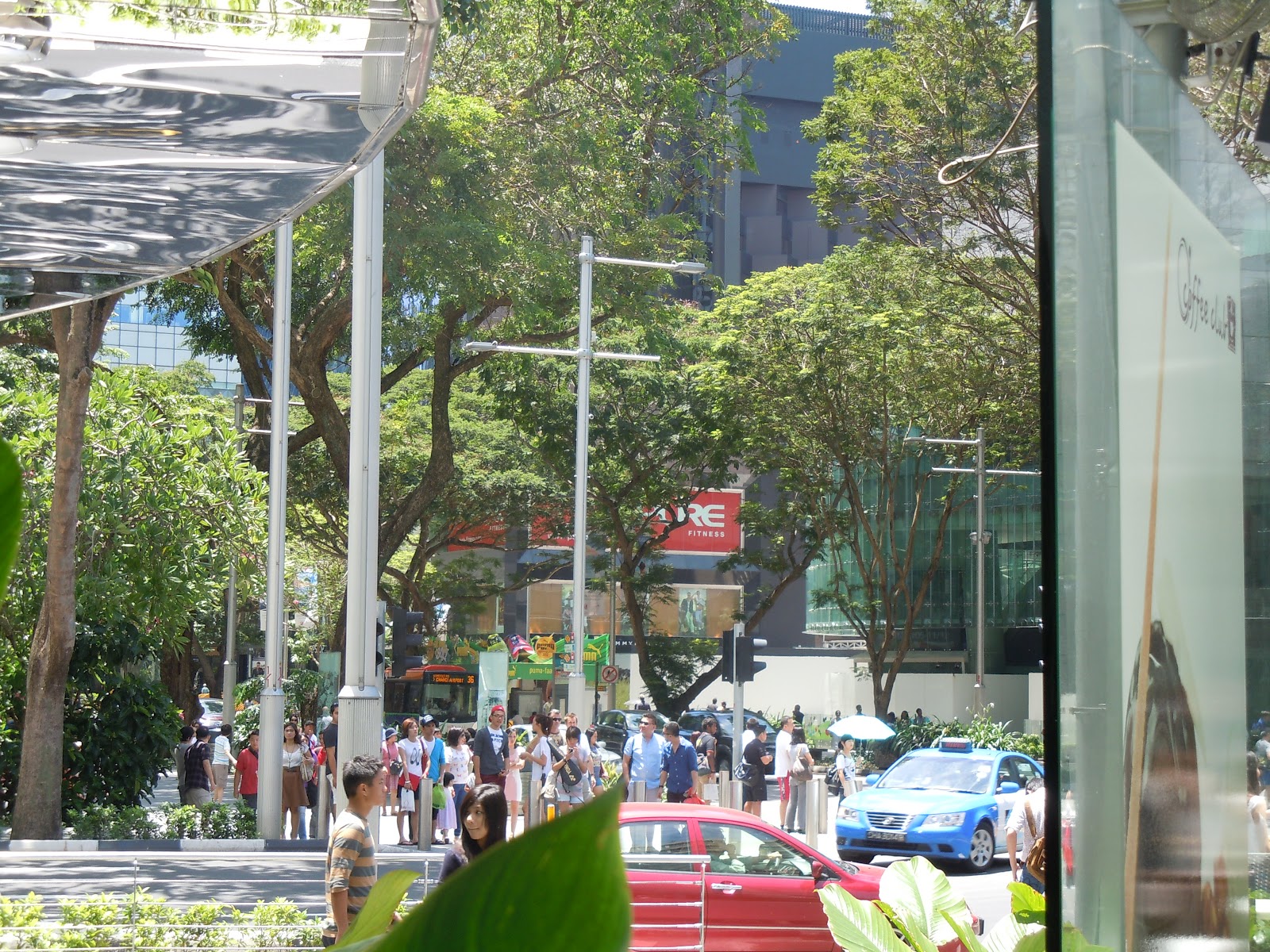
 Singapore is a beautiful place, clean and tidy, with lots of blooming trees and shrubs. There are palm trees everywhere and lots of tropical foliage; they manicure all the green space, even the hardwood trees so that they are spectacular. The architecture is fabulous—incredible high-rise apartment buildings, shiny skyscrapers and amazing hotels.  There is almost no litter and if there is, it’s being swept up as you walk by.  You cannot buy chewing gum at any price because it is illegal, but you can buy brandy if you have enough room on your credit card. 


Shopping On Orchard Road


Singapore is like Waikiki without the beach combined with New York City without the grime.  If you combined what it costs to visit both, you’d get an idea of what it costs to visit Singapore.  And there are plenty of rules.  You can’t eat or drink on the subway, but there are no trashcans if you mistakenly bring something with you.  Gail had to hide a water bottle in her purse to avoid the possibility of being fined. 
Marina Bay Sands Hotel


Chinatown

People here line up for everything:  getting a taxi, getting onto the subway, getting coffee at Starbucks (of which there are many).  We stayed at a nice hotel near Orchard Road, the main shopping area, and traveled mostly by taxi, which is just as economical for three people as the subway/buses and gets you exactly where you want to be.  The only problem was finding the place to line up for the next taxi. 

We also visited Little India and Chinatown, rode the giant Ferris wheel—the Singapore Flyer, proudly advertised as five meters taller than the London Eye, and took a boat cruise on the Singapore River.  We toured for a couple days on double-decker sightseeing buses, so we saw most of the city that way.

And the shopping:  Millie got earphones and clothes, Gail got a couple new rings and I picked up some new socks.  Actually, we had three suitcases full of stuff—plastic and glass containers for taking lunch to school, a new tip for Gail’s walking stick, beer-brewing supplies, theatrical supplies; did I mention clothes? 


Country Line Dancing in Chinatown


On the Singapore Flyer

Sunday, March 25, 2012

Notes from Independence Day

Not our school children going home

It’s been another busy week in Dhaka.  Our elementary school kids just finished their musical, Millie is working hard on her homework, Gail is grading papers, and I recovered from a 36-hour bout of food poisoning just in time to accompany a group of fifth graders on a tour of Dhaka’s municipal landfill, the largest city dump in Asia. 

The food poisoning was my own fault—eating a little slaw with my *Major Chain* Fried Chicken with Millie Monday night while Gail was at her French Cooking Class. As weight loss programs go, this was not all that effective. I loss some weight but missed my Total Body Workout Class and a Water Aerobics Class, have spent no time in the weight room and very little on the bike. 

Actually, the tour of the dump was most educational.  The culminating event of the Primary Years Program (International Baccalaureate in elementary schools) is an exhibition—5th graders research a portion of a general topic in small groups of four or five students, devise lines of inquiry and produce a final presentation.  This is the antithesis of the way school is taught in most places and certainly in Missouri (except for those two PYP schools in Springfield).  The students have mentors (me for the city dump group) as well as their teachers, but they decide which tangent they wish to pursue and how to pursue it…

Our fifth graders’ over-arching issue is “Sharing the Planet”, and each group has a different take on what to study.  The day of our trip a different group interviewed beggars in the streets (Dhaka has lots), another acid survivors (Dhaka has too many)—it’s all pretty incredible.  And then there are all those export-only garment factories paying 22 cents an hour.  Lots to study.

My group was interested in how things are reused and re-cycled, and started out considering air and water pollution.  While there’s plenty of that to study here—incredible color pictures of factories dumping toxic wastes into the rivers almost everyday in the newspapers—and lots of air pollution.   The place is exactly what the Koch brothers’ Tea Party is hoping for in America—no environmental restrictions and lots of poor people working for almost nothing. 

But I digress.  After only an hour or so on the road the five students, one dad, the driver and I, armed with cameras, surgical masks and gloves, found the landfill…a mound of trash, covered with a thin veneer of earth, the size of an American indoor football stadium and twice as long.  In a country without hills, it sticks out.  We had driven past shanties with bales of plastic and paper and two guys working through a field of trash just before we entered.  When our van pulled around the completed landfill to the active trash dump, we saw the real action.
Ready for Sale


Our five investigators
Four backhoes (the big ones, on tracks, with four-foot buckets) and a bulldozer were moving big piles of loose trash.  Every time a backhoe scooped a load, half a dozen women and children would pick through the trash for anything they could sell.  I was sure someone would get hit by a backhoe, but it didn’t happen while we were there.  I told our kids to be brave and we’d get out and take some pictures, but when I opened the van door, I realized there was an inch of black sludge beneath the van.


We drove to a dry piece of road before we got out.  We were immediately surrounded by the working kids and a few adults; our only Bangla-speaking student did all the talking, asking kids questions while we all took pictures.  The kids told him that they got paid and that they also went to a school nearby, although we didn’t see it.  After a few minutes of this we got back in the van, chased out the flies and headed back out via the office. 
Where the Action Is


The Workers Come to See Us


The Burlap Wagon


Getting Water at the Office


On the way home

The Streets of Dhaka


The main office is a relatively new looking building at one end of the main landfill, with a water spicket in the parking lot.  A man came out and spoke to us.  He told us he was the manager and that all the trash in Dhaka came here.  He also asked to see our permission letter.  Our driver showed the AISD bus authorization form, but that wasn’t it. It turns out you have to get permission from a government office to see the landfill.

Who knew that touring the city dump required permission?  We acted contrite and I assured him we had no idea, and by the way, could we ask a few questions? So the students got another interview and we got a few more pictures, including one with the manager. 


One of the things he told us was that those kids we had talked to were not paid; they were allowed to go through the trash (don’t know if they had to have a government permit) and sell whatever they could.  Which is where those bales of plastic and paper came from that we had driven by on the way into the landfill. 


We all got back in the bus and headed back to school.  The pictures are from the city streets on the way back to school.  Since some schools were letting out as we returned to ours; yes, that's a “school buses”.

Not an AISD school bus
About the language: Here it is Bangla; in Calcutta, it’s called Bengali.  It is distinct from Hindi, and indigenous to this area of the subcontinent, Bengal.  


The maintenance of local language is significant to the maintenance of cultural identity.  In 1952, when this was East Pakistan, college students were killed for protesting the imposition of Urdu as the official language of Pakistan.  In Bangladesh, those students are remembered as language martyrs, and people believe that this is the only place that revolted to protect its language.  Eventually, the events of 1952 led to the declaration of independence, March 26, 1971, 41 years ago today. 

Next week, Singapore. 


Sunday, March 18, 2012

St. Patrick's Day Edition


It’s been another happy week in Dhaka.  We went to a local wedding reception, the country has had some momentous events of late, and our girls’ soccer team hosted and won the conference tournament just as the drought ended. 

The wedding reception was our first real cultural experience here in Bangladesh.  The wedding itself was several months ago.  The bridegroom, Shaikat, is one of the tech guys at school.  We think we were invited (not everyone at AISD was) because he has to help us both so much with our computers—we’re so last century. 

Weddings in Bangladesh are frequently a hybrid of Hindu and Islamic traditions.  According to one of our AISD friends, Moslems don’t have a long, drawn out ritual, but the Hindu events can go on for several days.  The wife’s family hosts the wedding and whatever social events they want, then a few months later the husband’s family has a party/reception.  Both families come to both, but each invites friends as well. 

This reception was at a banquet center on the other side of town, but our driver found it, and Shaikat’s father greeted us on the sidewalk.  There were at least 200 people there; he took us inside, and upstairs past everyone else to the front row of sofas right in front of a bench- and flower-covered dais.  Shaikat stopped by to welcome us and let us know that Anika would arrive shortly.  

And then, there she was. 
Anika 
The reception was not so much a gifting and greeting event as a photo-op.  Anika sat on the dais, looking beautiful and perfect while three professional photographers and all the family members with cameras came up to take pictures.  The make-up is a three-hour process itself, we are told; I am not sure how long the henna on the arms and hands took. 

After 45 minutes of photography, we were escorted into the dining hall next door for traditional Bangladeshi buriyani.  We are almost the only ones who required utensils; everyone else ate with their right hands.  As soon as we had eaten, we were encouraged to come back to the photo-op; the tables were cleared and reset for the other 100 or so people.  At that point we were invited to the dais to have our photo taken with the happy couple.  That picture will be available in about a month.
The Happy Couple
The major school news is that AISD won the conference girls’ soccer tournament.  There were five teams—Overseas School Columbo (Sri Lanka), Lincoln School (Nepal), Lahore American School (Pakistan) and the American International Schools of Chennai and Bombay, respectively--here for the event.  We hosted two girls, Sujana and Prahbuti, from Nepal. 

Our team beat the OSC Geckos by one goal in a shoot-out after 90 minutes of regulation and 10 minutes of overtime just as the first storm in months hit.  It had been raining a little during the last minutes of the game, but began to really pour after we got home.  The lightning and thunder were pretty impressive, and there was about 6 inches of water in the street at one time.   

Water, or its lack, has been an issue recently.  Our school has, or had, a deep well that allowed us to have drinking water from water fountains, just like in Europe or America.  The safety and quality were checked regularly by the embassy people, and everything was good.  Then the pump failed.  Actually, a local company pulled the pump and found it to be working fine; there wasn’t any water in the aquifer anymore.  So we now have five-liter barrel-like water containers everywhere. 

Now that we have had a big storm, things may change again.  It's already better here--cleaner air and fewer mosquitos.  

We have also wondered if Bangladesh ever makes the local news back in America. 

For instance, the local opposition party, who sets records for boycotting parliament, called a big rally/protest/demonstration for downtown.  The party in power responded by closing the various means of entering the city—trains, buses and ferries were stopped, vehicles belonging to opposition party members were “confiscated”, armed groups of thugs allied to the party in power assisted the police in beating protesters, and the TV stations were taken off the air.  (Al-Jazeera covered it and our local newspaper kept printing.)

All the excitement took place on the other side of town from us; we were perfectly safe, by the way. 

Our Nepalese soccer players didn't mention the demonstration but asked about the passenger and freight ferry that was struck by an oil barge and sank in a river south of Dhaka killing almost 200 people.  That made the news in Kathmandu as well as here. 

Don't know if you heard about these: 
  • The Bangladeshi government won a case in a United Nations court giving it much more of the Bay of Bengal than either India or Myanmar wanted to give up; American oil companies are all excited. India would like to negotiate.   
  • Russia just gave Bangladesh a soft loan to build a nuclear reactor here for producing electricity.  They are just waiting on the government to write an energy policy that will insure that it will all be safe.  What could possibly go wrong?  

Meanwhile, the biggest issue here in the diplomatic enclave is that the government has decided that this is a great time to install storm sewers, so streets in the area are littered with 4’ concrete tubes waiting for ditches to be dug.  Consequently, traffic is worse than ever.